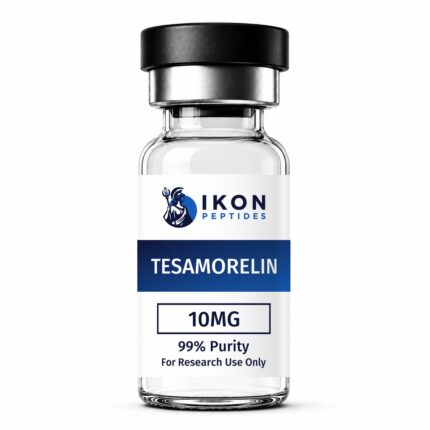
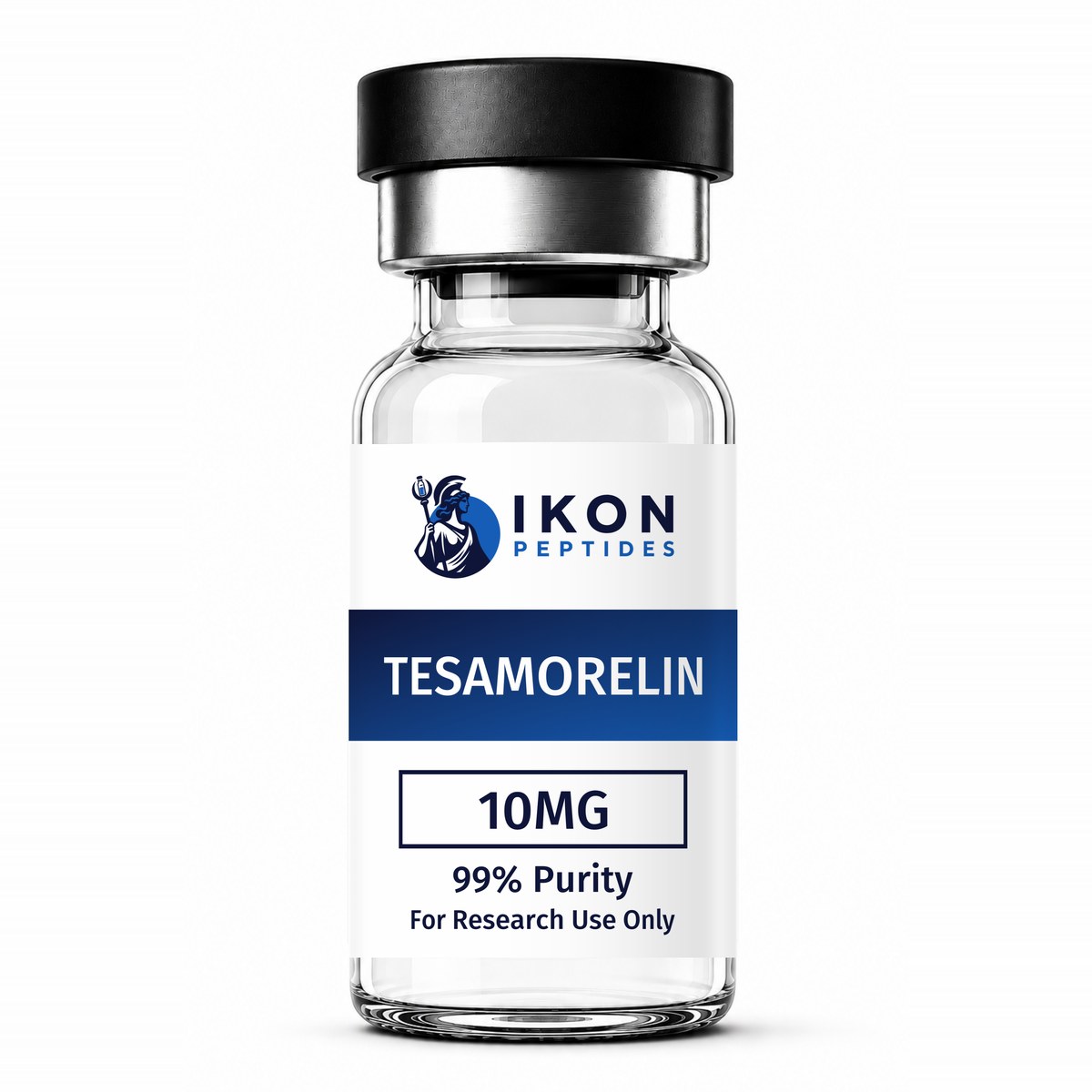
Tesamorelin 10MG
$49.00
Tesamorelin is a synthetic analog of growth hormone-releasing hormone (GHRH), consisting of the 44-amino-acid GHRH(1-44) sequence with a trans-3-hexenoic acid group attached to the N-terminus. That modification increases its resistance to enzymatic degradation compared with the unmodified sequence.
It binds the GHRH receptor on pituitary somatotroph cells, and is studied for the downstream signaling of that receptor interaction.
Researchers study Tesamorelin in:
- GHRH receptor binding and activation assays
- Somatotroph cell culture models
- Comparative studies against unmodified GHRH and other GHRH analogs
- Enzymatic stability studies
- Peptide formulation research
For research use only. Not for human or veterinary use.
MECHANISM
How Does It Work?
Tesamorelin works by mimicking the body’s own GHRH signal — triggering a natural, pulsatile release of growth hormone rather than flooding the system artificially. This is what makes it different from synthetic GH:
| Pituitary GH Stimulation | Visceral Fat Reduction |
|---|---|
| Tesamorelin binds to GHRH receptors in the pituitary gland, triggering a natural, rhythmic release of growth hormone. Because it works through the body’s own feedback system, it avoids the hormone spikes associated with synthetic GH administration. | Tesamorelin specifically targets visceral adipose tissue — the dangerous fat stored deep in the abdomen around internal organs. Clinical trials show up to 20% reduction in visceral fat, with minimal effect on subcutaneous fat elsewhere. |
| IGF-1 Upregulation | Muscle Preservation |
|---|---|
| By increasing growth hormone, Tesamorelin also raises IGF-1 (insulin-like growth factor 1) — a key anabolic hormone involved in tissue repair, muscle maintenance, and metabolic regulation. | While Tesamorelin burns visceral fat, it helps preserve lean muscle mass. Research models show improved body composition — less fat, same or more muscle — without the muscle-wasting seen in caloric restriction alone. |
| Triglyceride Reduction | Cognitive Research Applications |
|---|---|
| Studies show Tesamorelin reduces circulating triglycerides — a key cardiovascular risk marker closely tied to visceral fat accumulation and metabolic dysfunction. | Emerging research suggests Tesamorelin may support cognitive function in older adults through its effects on GH and IGF-1 — both of which decline with age and are linked to brain health and memory performance. |
Key distinction from synthetic growth hormone: Tesamorelin works with the pituitary’s natural feedback loop. The body still self-regulates — which means it avoids the suppression and rebound effects associated with exogenous GH in research models.
PHYSICAL PROPERTIES
Key specifications for handling and storage in laboratory settings:
| Classification | Synthetic GHRH analog — FDA-approved (brand: Egrifta SV) |
| Amino Acids | 44 amino acids + trans-3-hexenoic acid modification at N-terminus |
| Molecular Weight | 5,135.0 g/mol |
| Form | White lyophilized powder |
| Solubility | Reconstituted with sterile water. Water-soluble. |
| Purity | 98%+ (HPLC verified) |
| Administration | Subcutaneous injection |
| Storage | Refrigerated 36-46 F (2-8 C). Protect from light. Avoid freeze-thaw cycles. |
| Stability | 24 months lyophilized. Use within 30 days once reconstituted. |
POTENTIAL SIDE EFFECTS IN RESEARCH
Tesamorelin has been evaluated in large Phase 3 clinical trials — giving it one of the most comprehensive safety datasets of any research peptide. Side effects are generally mild to moderate. Researchers should monitor and document all observations.
| Injection Site Reactions | Joint & Muscle Aches |
|---|---|
| The most frequently observed effect in Phase 3 trials — reported in approximately 25% of subjects. Includes mild redness, swelling, or discomfort at the injection site. Generally well-tolerated. | Mild joint pain or muscle aches have been noted, consistent with GH-axis activation. Typically transient and dose-dependent. |
| Fluid Retention | Elevated IGF-1 Levels |
|---|---|
| Mild peripheral edema (fluid retention) has been observed in some subjects. Consistent with GH stimulation. Researchers should monitor in longer-term protocols. | As expected with GH stimulation, IGF-1 levels rise during research protocols. Monitoring IGF-1 is recommended in study designs. |
| Blood Sugar Changes | Carpal Tunnel (Rare) |
|---|---|
| Tesamorelin may affect glucose metabolism. Subjects with existing metabolic conditions require closer monitoring of blood sugar markers throughout the protocol. | Reported in approximately 2% of subjects in Phase 3 trials. Consistent with GH-axis pharmacology. Rare at standard research concentrations. |
In 52-week Phase 3 clinical trials, Tesamorelin was described as ‘generally well tolerated’ with no significant elevations in fasting glucose at standard doses. It is not recommended for use in active malignancy or pituitary disorder research models.
DISCLAIMER
This product is exclusively for laboratory research. Not approved for human or veterinary use.
All products sold by Ikon Peptides are intended exclusively for in-vitro laboratory research. Not approved for human consumption or veterinary use. These statements have not been evaluated by the FDA.
MAECENAS IACULIS
Vestibulum curae torquent diam diam commodo parturient penatibus nunc dui adipiscing convallis bulum parturient suspendisse parturient a.Parturient in parturient scelerisque nibh lectus quam a natoque adipiscing a vestibulum hendrerit et pharetra fames nunc natoque dui.
ADIPISCING CONVALLIS BULUM
- Vestibulum penatibus nunc dui adipiscing convallis bulum parturient suspendisse.
- Abitur parturient praesent lectus quam a natoque adipiscing a vestibulum hendre.
- Diam parturient dictumst parturient scelerisque nibh lectus.
Scelerisque adipiscing bibendum sem vestibulum et in a a a purus lectus faucibus lobortis tincidunt purus lectus nisl class eros.Condimentum a et ullamcorper dictumst mus et tristique elementum nam inceptos hac parturient scelerisque vestibulum amet elit ut volutpat.